Topical Authority Is Not About Coverage. It Never Was.
AI made it easy to publish faster. It also made it easy for teams to mistake output for authority.
That mistake is everywhere right now.
Brands assume that if they cover more keywords, ship more articles, and move faster than before, they are building topical authority. Many are doing the opposite. They are scaling thin ideas, generic angles, and undifferentiated content that gives the right buyers almost no reason to trust them.
This isn’t just an SEO problem.
It is a trust problem.
Now that AI handles the drafting, topical authority is not about publishing more content. It’s about building a structured content system around your brand, your target audience, and your buyer personas so the right people can see, trust, and choose your expertise.
AI can accelerate that system. It can’t replace it.
Without the right foundation, AI does not create authority. It scales filler.
Topical Authority Was Never Just Topic Coverage
A lot of the current debate around topical authority gets the problem wrong. Topical authority was never supposed to mean publishing the most pages on a subject. It was never a race to cover every keyword or build the biggest cluster.
Topical authority has always been about whether the right audience sees your brand as a credible source on a meaningful area of expertise they care about. Coverage is one input. It was never the definition.
Google’s E-E-A-T framework points in the same direction: experience, expertise, authoritativeness, and trustworthiness. Those signals aren’t about the number of pages you publish. They’re about whether the content demonstrates real knowledge, comes from a credible source, and earns trust with the people reading it.
Backlinks and brand mentions are no different. They’ve always been authority signals, but they’re earned downstream as a result of content worth referencing. E-E-A-T isn’t a separate project from topical authority. It’s what topical authority looks like when it’s working.
When I started out with SEO, I used the keyword research approach just like everyone else. Build a list of long-tail keywords, write articles for all of them, and link between pages by scanning for matching words in other posts. There weren’t real clusters. There wasn’t a linking strategy. It was haphazard, and it worked well enough because Google was still a keyword-matching engine.
Then Hummingbird changed the game in 2013. Google moved from matching keywords to understanding meaning. Suddenly the old approach wasn’t enough. That’s when I started rethinking what topical authority actually requires.
The confusion still shows up in how teams build topical maps. They treat the map like a coverage plan, a list of keywords to hit organized by category. The map is rarely the problem. The problem is that teams use it as an inventory instead of a strategic structure for buyer trust.
Topical maps still matter. Structure still matters. Clusters still matter. But none of them create authority on their own. They only work when they are shaped by something upstream: a clear understanding of who the brand serves, what those buyers need, and why the brand’s expertise is worth trusting.
The goal is not to cover more.
The goal is to be the brand buyers trust when the stakes are real.
Why Cheap Production Amplifies Bad Strategy, Not Just Bad Writing
AI did not break content strategy. It exposed who never had one.
If your brand positioning is vague, AI will generate vague content faster.
If your audience definition is fuzzy, AI will produce pages that sound acceptable but fail to speak to the people who actually buy.
If your buyer personas are unclear, AI will miss the objections, evaluation criteria, trust signals, and decision context that separate useful content from forgettable content.
The failure usually starts before the draft.
This is the line more teams need to internalize:
AI does not create strategy, it amplifies whatever strategy you give it.
That amplification can be helpful when the inputs are strong. It can also be damaging when the inputs are weak.
That explains why so much AI-assisted content feels interchangeable. The issue is not that AI wrote it. The issue is that the system behind it had no strategic depth to amplify in the first place.
When teams skip the foundational work, they usually get content that is:
- broad instead of buyer-relevant
- fluent but non-essential
- technically on-topic but commercially disconnected
- repetitive across pages
- easy to publish and easy to ignore
That is not authority.
It is just content volume wearing better clothes.
The Real Foundation Is Brand, Target Audience, and Buyer Personas
Before a brand can build authority around topics, it has to answer something more basic.
Who is this actually for?
Not in a generic market-segment way. In a real strategic way.
A brand needs clarity on:
- who it serves best
- what problems it solves
- what outcomes matter to those buyers
- how those buyers evaluate options
- what objections slow down decisions
- what proof builds confidence
- what tone, angle, and depth match their level of sophistication
This is where many content systems break.
They start with keywords before they establish audience logic.
They start with article ideas before they define brand position.
They start drafting before they understand what buyers actually need in order to trust the brand.
That sequence almost guarantees generic output, which is exactly why so many topical maps underperform. The map gets built around search volume instead of audience priorities, decision friction, and commercial intent.
If you want topical authority that compounds, the order matters. Strategy has to start upstream.
That is why the stronger workflow is:
brand foundation -> target audience -> buyer personas -> topical map -> detailed brief -> draft -> publish -> measure
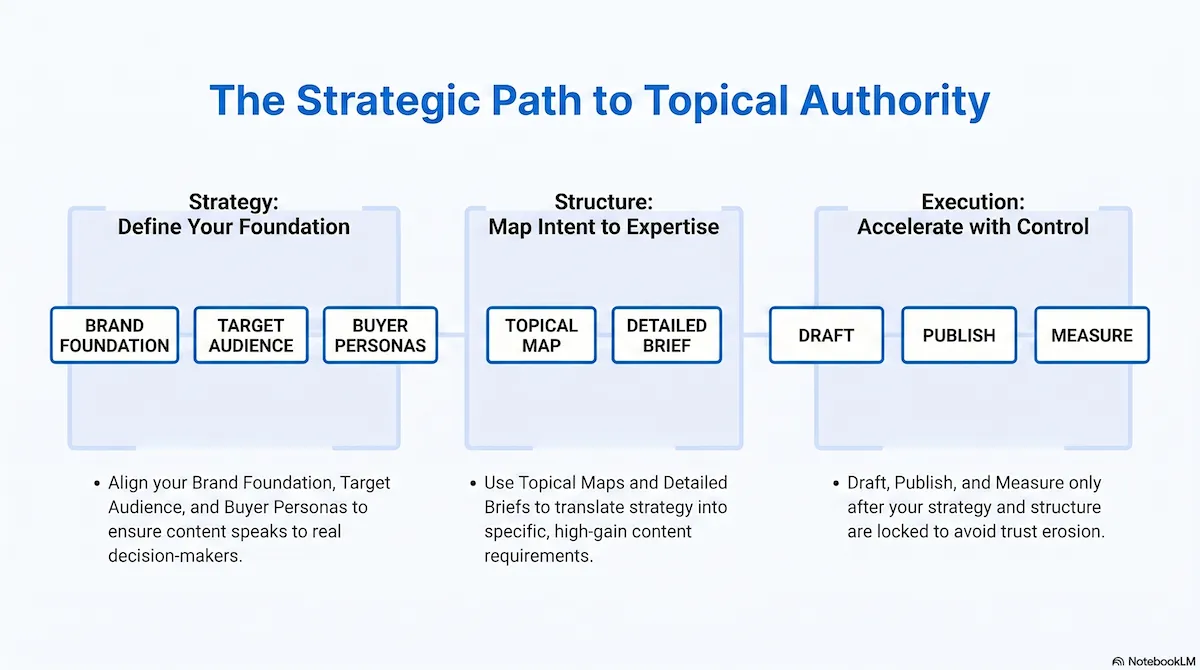
The map is shaped by those upstream inputs. The brief translates them into execution. The draft comes after the strategy is already specific. This is the sequence I teach in the Topical Maps Unlocked course and it’s the sequence Floyi is built around.
Authority is not built by isolated articles. It is built by a system that connects brand position to audience needs, buyer-persona logic, and structured execution.
What a Topical Map Actually Is, and What It Is Not
A good topical map is the structure that helps a brand decide what it needs to say, in what order, for which audience segments and buyer personas, and with what level of depth.
It should reflect:
- buyer needs
- target audience priorities
- persona-specific questions and objections
- topic relationships
- commercial relevance
- stages of awareness
- depth of expertise
- supporting subtopics, questions, and fan-out queries
- where proof, examples, and differentiation need to appear
A topical map is not a publishing checklist. It’s the structure that turns expertise into a scalable content system.
Semantic SEO reinforces why this matters. Search engines use NLP to evaluate meaning and relationships between concepts, not just keyword matches. A well-built topical map is inherently a semantic structure. It reflects how ideas connect and how entities relate to each other within the knowledge graph.
The structure of your topic coverage matters more than the exact phrases you use.
Topical authority can also outweigh domain authority. A smaller site with genuine depth on a focused subject can outrank larger, higher-DA sites that only cover the same topic superficially. AI search rewards the most thorough source, not the biggest one.
Many teams say they have a topical map when what they really have is a keyword inventory with categories. That may help organize production. It doesn’t create authority.
Here is what the difference looks like in practice.
Say a B2B project management tool wants to build authority around “resource planning.” The primary persona is an operations director at a mid-size agency evaluating tools after a failed project.
The difference between a keyword inventory and a strategic map looks like this:
| Keyword inventory | Strategic map (ops director, mid-size agency) | Why it matters |
|---|---|---|
| what is resource planning | what is resource planning for agencies | Foundational — but scoped to the persona’s context, not a generic definition |
| resource planning best practices | how agencies recover from resource planning failures | Awareness — addresses the trigger event that starts the buyer’s search |
| resource planning vs capacity planning | what operations directors get wrong about utilization tracking | Problem reframe — builds credibility with the persona |
| resource planning tools | how to evaluate resource planning tools when your team resists change | Objection handling — directly tied to buying friction |
| resource planning template | building a resource planning workflow your PMs will actually use | Conversion support — bridges to the product |
Every term in the left column is technically on-topic. But none of them are shaped by who the brand is trying to reach or what those buyers actually need to decide.
The strategic map still covers the basics. A page on “what is resource planning” still belongs. But instead of a generic definition written for anyone, it’s scoped to the persona’s world.
Compare the opening lines. A generic version might start:
Resource planning is the process of identifying, allocating, and managing resources to achieve project goals efficiently.
A persona-aware version might start:
Resource planning is how agencies match available people, time, and budget to active and upcoming client projects. For multi-client agencies, that means forecasting capacity across accounts, catching utilization gaps before they become staffing crises, and giving ops directors a real-time view of who is overbooked and who is underused.
Same topic. One talks to everyone. The other talks to the operations director who is already dealing with the problem. That foundational page does two jobs: it answers the search query and it starts building trust with the right buyer.
When that operations director searches in Google, ChatGPT, or Perplexity, which source gets surfaced — the one written for operations directors or the generic one? With search engines and chatbots becoming increasingly personalized for searchers, I’d put my money on the brand that has a strategic map.
A real topical map is shaped by the brand, the audience it wants to win, and the buyer personas it needs to move. A map built for “the market” usually produces content for no one in particular.
A good map also defines internal linking structure. Which articles support which, where a reader should go next, how subtopics connect to pillar content. That’s how search engines understand the depth and coherence of your coverage.
A topical map without a linking architecture is a collection of pages, not a system.
Structured data reinforces the same signal. Schema markup helps search engines and AI systems parse your entity relationships, content types, and topical scope. It’s not a substitute for depth. But without it, search engines have to guess at structure you could have just told them.
None of this is a one-time project. Content freshness matters too. Updating existing pages with current data and new examples signals that your expertise is current and offers information gain. Your competitor articles will continue to be stale.
A topical map that gets built once and never maintained loses authority over time. It doesn’t matter how strong it was at launch.
This matters even more now that production is cheap.
Once drafting gets fast, the bottleneck is no longer typing speed. It’s strategic structure. Teams with a real map can move faster without losing coherence.
Teams without one usually produce disconnected content that lacks topical ownership, cannibalizes each other’s rankings, wastes budget, and says very little a buyer will remember. That’s content cannibalization, and it almost always traces back to a map built without strategic intent.
That is usually the point where the brief either saves the system or exposes it.
Why the Brief Is the Quality-Control Layer Most Teams Skip
This is where the gap widens and gets expensive.
Even teams that believe in strategy often jump too quickly from topic selection to drafting. They have a map, or at least a list of target articles, and then they move straight into generation.
That shortcut is one of the main reasons AI-assisted content turns generic.
The missing layer is the brief.
A real brief isn’t a formality. It’s not a thin outline with a target keyword, list of H2s and a suggested word count. It is the point where strategic intent becomes writing guidance strong enough to protect quality before the draft exists.
This is where you define:
- the angle
- the audience fit
- the primary buyer persona
- the scope
- the search and buyer intent
- the core argument
- the evidence or examples needed
- the differentiation points
- the brand positioning constraints
- the trust signals that matter
- what should not be said
That last point deserves emphasis. Exclusion criteria are often more valuable than inclusion lists. Knowing what to leave out prevents scope creep, off-brand tangents, and the kind of “cover everything” instinct that produces forgettable content.
Most teams only think about what to include. The brief is where you also define what to cut.
That is the step many teams skip, and it is exactly the step that keeps filler, non-essentials, and generic AI slop out of the draft in the first place.
If the topical map gives you structure, the brief gives you control.
It is the quality-control layer that decides whether the draft will be sharp, credible, commercially relevant, and persona-aware, or just another polished page saying what everyone else already said.
This is also where a system like Floyi makes practical sense. Not because it magically writes better on its own, but because the workflow enforces that sequence: drafting never starts until the foundation, map, and brief are already in place.
That order is what protects trust, which is why the next problem matters more than most teams admit.
Low-Delta AI Content Is Trust Erosion at Scale
A lot of teams still describe shallow AI content as a visibility problem.
That is true, but it is not enough.
Low-delta content, content that adds almost nothing beyond what already exists on the topic, doesn’t just weaken rankings. It trains buyers to trust you less.
This is directly tied to information gain: the measure of how much new, useful understanding a page provides compared to what is already available.
Search engines use information gain to evaluate whether a page deserves to rank. Buyers use it instinctively to decide whether a brand is worth their attention. When a page offers zero information gain, it does not matter how well it is written. It is noise.
When buyers keep encountering pages that are technically relevant but strategically empty, they learn something about the brand. They learn it can sound informed without being especially useful. That it can produce content, but may not have much to say.
That is trust erosion.
And when every competitor can publish at the same speed, it compounds quickly.
A big part of the problem is the one-shot shortcut: type a prompt, get an article in seconds, call it authority. That workflow is attractive because it feels efficient. In practice, it usually produces shallow, low-delta content with familiar framing, weak differentiation, and very little evidence of real expertise.
One-shot generation without strong inputs usually creates the same pattern:
- safe framing
- familiar wording
- broad advice
- thin differentiation
- little proof
- very few genuinely necessary ideas
The result is content that may look finished but does not help the buyer make a better decision or give them a stronger reason to choose.
And it doesn’t just create forgettable content. It wastes budget, absorbs team time, and makes the brand easier to ignore in both search and buying decisions.
Shallow, repetitive AI content is not just weak SEO. It is trust erosion at scale.
And once a brand becomes associated with generic output, publishing more of it rarely fixes the problem.
What Smart Teams Should Do Instead
The alternative is not to reject AI.
It is to use AI inside a stronger system.
Smart teams start earlier and sequence the work properly.
They:
- define brand position clearly: what the brand stands for, what it does differently, and why its perspective matters
- define the target audience and build buyer personas grounded in real decision behavior, not demographics
- create a structured topical map based on expertise, commercial relevance, and persona-specific needs
- write detailed briefs that lock in angle, scope, proof, differentiation, and what to exclude
- use AI to accelerate drafting inside those constraints
- publish, then measure visibility and trust signals across both traditional search and AI search
Step 3 is where most teams think the work starts. Steps 1 and 2 are where authority is actually won or lost. A topical map built without clear brand position and buyer understanding is just a keyword plan with better formatting.
Step 4 is where most teams think quality control happens. In practice, the brief is where it happens. A strong brief makes it hard to produce a generic draft. A missing brief makes it almost inevitable.
Step 6 is also undervalued. Authority isn’t just a publishing activity. It’s measurable, and not just in Google rankings. AEO and GEO measure whether your content gets mentioned and cited in AI-powered search. Floyi tracks authority across both traditional and AI search, so teams can see where their expertise holds and where it doesn’t.
This is slower at the beginning than jumping straight into generation.
But it is much faster if the goal is to build authority that lasts.
Real efficiency is not producing more drafts per day. Real efficiency is producing fewer weak pages, fewer redundant pages, fewer off-brand pages, and fewer pages buyers read without caring.
When strategy is structured, AI becomes leverage.
When strategy is weak, AI becomes a multiplier for confusion.
The Standard for Authority Just Got Higher
Topical authority is not dead. Most teams are just measuring the wrong thing.
Cheap, fast drafting didn’t make topical maps obsolete. It made them more important, and it exposed how often teams misuse them.
It didn’t remove the need for strategy. It made weak strategy impossible to hide.
It didn’t make briefs optional. It made them essential.
If brands want to earn trust now, they need more than coverage. They need clear positioning, real audience understanding, buyer-persona logic that reflects how people actually decide, topical maps shaped by those inputs, and strong briefs that keep execution aligned before the draft ever starts.
The brands that win will be the ones that make their expertise easier for the right buyers to understand, trust, and choose.
That is the real standard for topical authority now that everyone can publish.
If you want to build topical authority with this workflow, from brand foundation through topical maps, briefs, and measurement, Floyi is built to run the full sequence. Try it free.
If you want hands-on help building this for your brand, reach out to me directly for consulting.