Your SaaS Blog Isn't Losing Because of AI. It's Losing Because Google Doesn't Know What You Own.
I keep hearing the same explanation from SaaS teams watching traffic decline: AI search changed everything.
The story usually sounds like this: the blog used to bring in steady organic traffic, AI answers started appearing, clicks dropped, and now SEO feels less reliable.
That diagnosis is too convenient.
AI may be taking some clicks. But for many SaaS blogs, the deeper problem is that Google never had a clear enough understanding of what the company deserved to own.
The blog had pages. It had keywords. It may even have rankings.
But it didn’t have topical ownership.
By ownership, I don’t mean ranking for every keyword. I mean Google, buyers, and AI answer systems can clearly associate the brand with a specific category, problem, workflow, or buying situation.
That distinction matters more now because search is no longer just a list of blue links. Google, AI Overviews, ChatGPT, Gemini, Perplexity, and other answer systems are trying to decide which brands belong with a problem, a category, a workflow, or a recommendation.
These systems don’t work the same way, but they all reward clearer associations between entities, problems, workflows, and proof.
If your site doesn’t make that relationship obvious, you are asking the system to infer your positioning from scattered clues. Internal links are part of the problem. Most teams use site: search to find pages with matching keywords and link them together. That gets pages connected, but it doesn’t build a topical hierarchy.
Linking from page A to page Z because they share a keyword doesn’t explain the relationship between those topics or guide Google through a logical path. Internal links should reflect the structure of the topic, not just keyword overlap.
Building organic growth on inference and haphazard linking is fragile.
AI Didn’t Create the Problem. It Exposed It.
When a SaaS blog loses traffic, the team usually points to the newest visible threat:
- AI summaries are answering the query.
- Google is showing fewer organic results above the fold and on Page 1.
- A Google core update or quality update changed which sites Google trusts for the topic.
- Buyers are asking ChatGPT instead of searching Google.
- Review sites, communities, and listicles are owning more of the decision journey.
All of that can be true, and still not be the root problem.
The data behind the narrative is real:
- Ahrefs analyzed 300,000 keywords. AI Overviews reduce organic CTR by 58%.
- Pew Research tracked 68,000 real searches. Users click a result only 8% of the time when an AI summary appears, compared to 15% without one.
- HubSpot’s CEO Yamini Rangan said at SaaStr Annual + AI Summit: “Search is gone… AI overviews are actually providing answers. So waiting for search to lead traffic to your website is gone.”
- LinkedIn disclosed up to a 60% drop in non-brand B2B awareness traffic while rankings were stable. LLM-driven traffic saw triple-digit growth, and LinkedIn is the #2 most-cited source in AI search behind YouTube. Even that wasn’t enough to offset the loss. They created an internal AI Search Taskforce in response.
AI is taking clicks. That part isn’t wrong.
But the companies with the most dramatic traffic losses tell a different story when you look closer.
HubSpot’s blog traffic dropped from 13.5 million to 8.6 million monthly visits in a single month. The narrative pointed to AI. Aleyda Solis analyzed the actual pages that dropped and found the losses were concentrated in off-topic content: resignation letter templates, famous quotes, shrug emoji explainers. Google’s core update reclassified those pages as search-engine-first content. HubSpot’s core CRM and marketing automation rankings stayed intact. That wasn’t an AI problem. That was a content quality correction.
When Graphite analyzed 40,000 of the largest US websites, overall SEO traffic had declined just 2.5% year over year — not the 25-60% the loudest case studies implied. The drops were concentrated in mid-sized sites and informational categories like news, health, and entertainment. Commercial and transactional content held up.
Grow and Convert found the same pattern across 20+ SaaS clients: bottom-of-funnel content saw only 10–20% traffic declines, and conversions held steady or grew. The damage was concentrated in broad, informational, top-of-funnel content — the exact kind of traffic that never had strong ownership behind it.
The pattern is consistent. AI is compounding the problem. But the root cause in most of these cases was structural.
When I audit SaaS content programs, I find the same thing: the site has been publishing around topics without proving what the company should be known for. The blog will have dozens of posts. Use-case pages won’t exist. Product pages will be orphaned from the content that should feed them. And the internal links will point to loosely related posts instead of pages that matter commercially.
ClickUp is a useful example because the visible drop was dramatic, but the underlying pattern wasn’t unique. In January 2025, ClickUp’s blog was bringing in 1.19 million organic visits per month. By April 2026, Kamila Olexa found it was down to 28,790, a 97.6% decline.
Her ClickUp breakdown is worth reading because she doesn’t reduce the drop to one cause. She maps the decline against multiple Google updates, then shows how ClickUp’s response made the problem worse: more templated posts, more promotional pages, very little pruning, and losses across both edge topics and core commercial queries like “task management software” and “free project management software.”
Here’s the part that matters most: the off-topic expansion didn’t stay isolated. Once Google lost confidence in the blog section, even pages tied to ClickUp’s core category lost ranking visibility and traffic. The damage spread from the edges to the center.
ClickUp is the extreme version, but the pattern shows up in smaller SaaS blogs all the time. The team may have chased keywords with search volume. They may have copied competitor blog categories and keywords. They may have built a glossary because every other SaaS site in the category had one.
The result can look successful in a traffic dashboard and still be strategically weak.
That kind of traffic was always vulnerable.
AI didn’t make weak content strategies weak. It made the weakness visible.
AI taking clicks is the easy story. The harder one is whether Google clearly understood what your SaaS company owned before the interface changed.
A quick test: pull your top 20 organic landing pages and ask whether each page strengthens the connection between your brand and the topic you want to own. If most pages only answer broad informational queries with no product context, the issue isn’t AI. It’s unclear ownership.
A SaaS Blog Is Not a Strategy
A blog is a container. It isn’t a strategy.
Most of the content programs I audit have the same foundational issue: nobody defined what the company should be known for before the blog calendar started. Topics get picked for search volume. The content calendar fills up. And the product becomes harder for Google to understand with every post that doesn’t connect back to it.
The pattern usually looks familiar:
- A few broad “what is” posts
- A set of generic how-to articles
- A glossary that nobody internally uses
- A handful of competitor comparison pages
- Product feature pages that sit apart from the blog
- Maybe a few customer stories or landing pages
- Thin use-case pages built after the blog calendar is already moving
- Many posts based on long-tail, low-competition keywords from keyword tools
The problem isn’t that these assets exist.
The problem is that they don’t work together.
A SaaS site needs more than content. It needs a clear set of relationships between the company, the category, the product, the buyer, the problem, and the workflow. Those relationships show up in how pages connect to each other, how internal links explain the topical hierarchy, and how proof supports the product.
If the blog says one thing, feature pages say another, comparison pages sit in isolation, and use-case pages barely exist, Google has to infer what the company is actually about. That inference should not be left to chance.
The Authority Anchor Comes Before the Topical Map
Before the blog calendar, there are three things I want to see: the authority anchor, the topical scope, and the topical map.
The authority anchor is the core topic the brand wants to own: a category, problem, use case, or workflow where the company should become a recognized authority.
The right anchor sits at the level where buyers already think about the problem. If the company sells payroll software, the anchor is “payroll software,” not “HR” and not “direct deposit.” One is too broad, the other is too narrow. The anchor should be specific enough that a buyer would recognize the association, and broad enough that a full topical map can be built underneath it.
You can think of it as the core topic behind the strategy. The anchor isn’t every major section in the topical map. Those major sections are pillar topics, also called main topics. Both terms describe the same thing: the top-level categories that organize the map under the anchor.
The topical scope defines what belongs under that anchor. It includes the main topics, subtopics, supporting pages, and proof needed to make the anchor believable.
The topical map turns that scope into structure. It shows how the core topic breaks into pillar topics, how pillar topics break into deeper subtopics, and how those subtopics become pages, briefs, internal links, and publishing priorities.
The order looks like this:
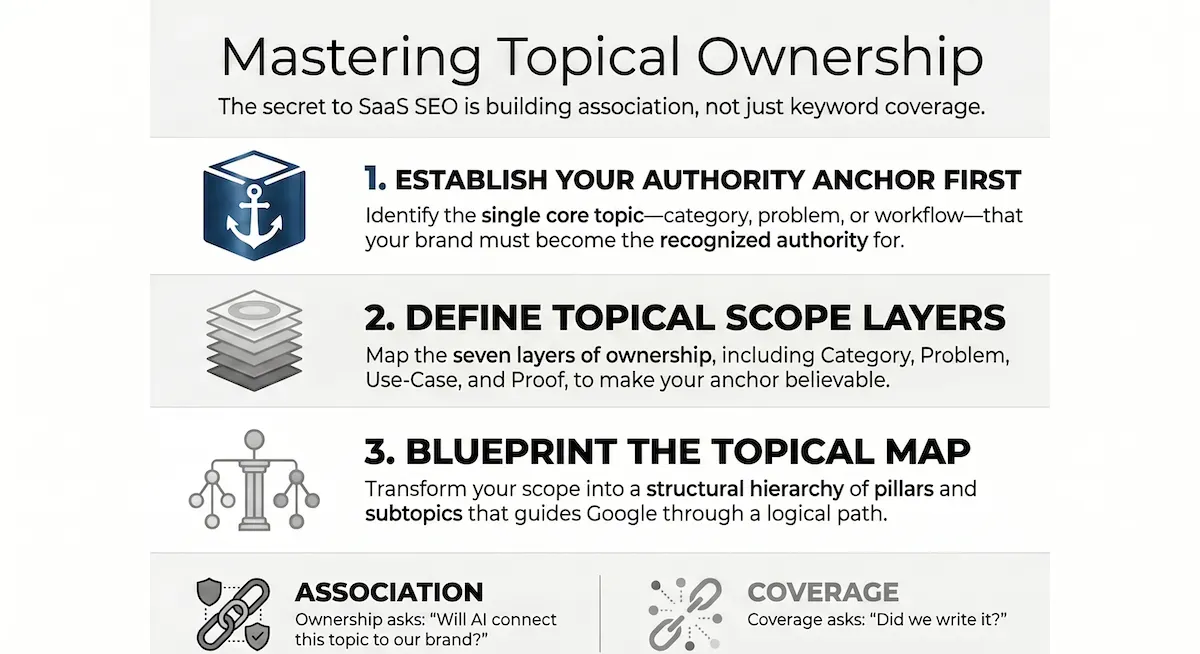
Anchor first. Scope second. Map third.
Some companies think they need multiple anchors because they have multiple features or product lines. Often, those features still fall under one unifying anchor.
A project management tool with docs, boards, and time tracking doesn’t need three anchors. It needs one anchor — project management software — with task management and resource planning as pillar topics inside the scope. If the company truly operates across separate categories — CRM and marketing automation, for example — then each anchor gets its own scope and map. But the default should be fewer anchors, not more. The framework forces prioritization.
Most SaaS blogs skip that order.
The Failing SaaS Blog Pattern
The most common SaaS blog mistake isn’t bad writing.
It’s disconnected strategy.
I’ve walked into content programs that looked productive from the outside and found this structure underneath: active blog calendar, weak product context, and no clear connection between the content being published and the problems the product actually solves.
The brand foundation is missing. The audience and buyer personas were never defined. The content team is writing for keywords, not for the people who actually buy the product. I covered why every topical map needs to start with the brand and audience because this is the step most teams skip.
The result is a site with many URLs and weak meaning.
Which is why traffic can exist without authority. A blog post can rank for a query and still do very little to make the brand more defensible.
This is especially dangerous in SaaS because product context matters.
A project management tool shouldn’t just write about productivity. It should make clear which workflows it improves, which teams it serves, which execution problems it solves, which alternatives it replaces, and which buying moments it belongs to.
A payroll tool shouldn’t just write about HR tips. It should own the compliance, operations, employee classification, state-by-state payroll, and finance workflows that make the product valuable.
A customer support platform shouldn’t just write about customer experience. It should own ticket routing, AI support automation, response quality, help center structure, escalation workflows, and support team performance.
If the site doesn’t make those connections, Google sees content. It doesn’t see ownership.
The dangerous part is that this pattern can still show positive numbers. Organic sessions rise. Impressions rise. Rankings appear across hundreds of informational queries. But traffic isn’t the same thing as ownership. Here are the warning signs I look for:
- The top organic landing pages are broad educational posts with weak product connection.
- Readers rarely move from blog posts to use-case, feature, comparison, or demo pages.
- The homepage uses one category language, while product pages and blog posts use another.
- Product pages are orphaned from the educational content that should support them.
- I consistently find that the sales team doesn’t use the blog because it doesn’t explain real buyer problems.
- Comparison pages only target direct competitors and ignore the old workflow the buyer is replacing.
- The site can’t answer what topic it should own in one sentence.
- The content calendar is driven by keyword volume instead of category, problem, or use-case ownership.
If a SaaS blog brings in visitors but doesn’t help Google understand the product, the buyer, and the buying problem, the traffic is doing less strategic work than the dashboard suggests.
Google Needs to Know What You Own
Topical ownership isn’t the same as topical coverage.
Coverage asks, “Have we written about this topic?”
Ownership asks, “Would Google, buyers, and AI answer systems connect this topic to us?”
The second question is harder, and the one that matters.
For SaaS, I define topical scope through seven ownership layers. These are the layers I’ve seen matter most across 300+ content audits. Other dimensions exist — integrations, pricing, community — but they usually live inside one of these seven. These layers aren’t separate from the authority anchor. They are the parts of the scope that make the anchor believable.
They are also not the same as pillar topics. Pillar topics organize the map. Ownership layers audit whether the map proves the right things.
The seven layers are:
- Category ownership: What market do you belong to?
- Problem ownership: What painful problems should buyers connect to you?
- Use-case ownership: What jobs does the product help people complete?
- Buyer-role ownership: Which roles should see the product as relevant?
- Alternative ownership: Which tools, workflows, or old ways are you compared against?
- Workflow ownership: Where does the product fit inside the buyer’s day-to-day process?
- Proof ownership: What evidence makes your claims believable?
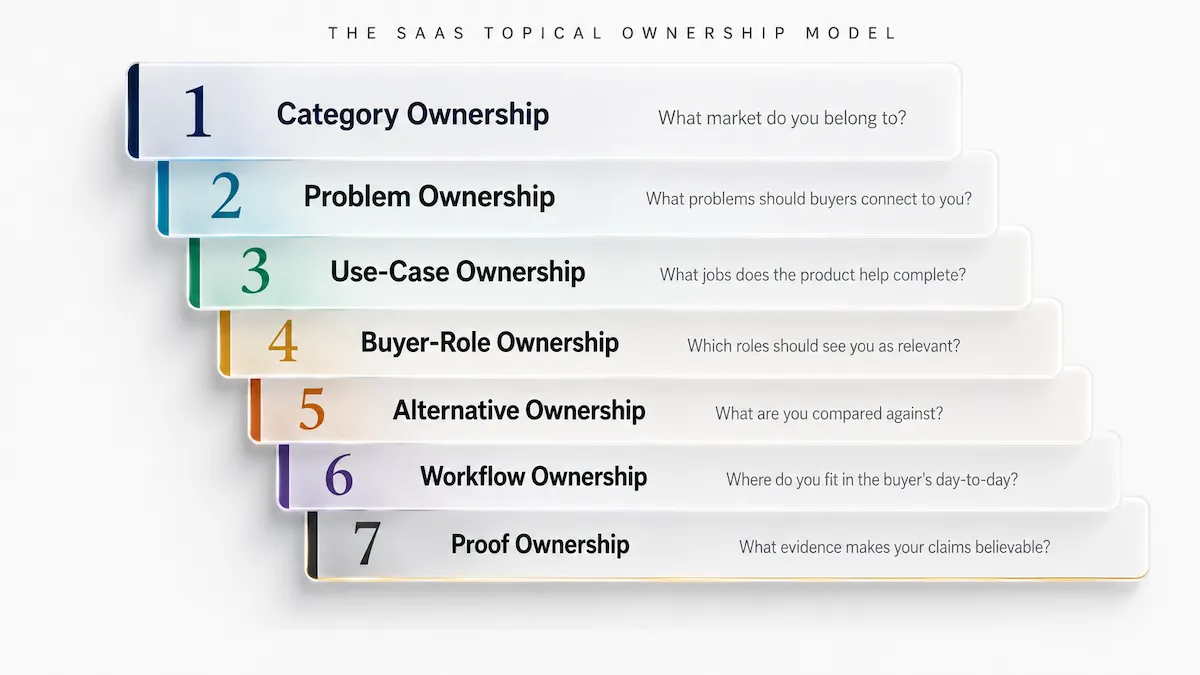
Category and use-case ownership come first. Without those two, the other five layers have nothing to anchor to. A site that nails category and use-case clarity before expanding into problem, alternative, and workflow content builds a stronger foundation than one that publishes across all seven layers without depth in any.
A SaaS blog that only publishes informational posts usually touches one or two of these layers.
A SaaS site that connects all seven builds the association that matters.
That connection is what helps Google understand that the brand isn’t just writing about a topic. The brand belongs in the set of companies, examples, and sources that should be considered for that topic.
The SaaS Topical Ownership Model
The fix isn’t to publish more blog posts.
The fix is to build a site that explains what the company owns.
To make each layer concrete, I’ll use two examples throughout: a generic payroll software company and Floyi, the topical authority platform I built. Showing how we apply this framework to our own product is the clearest way to demonstrate it.
1. Category Ownership
Category ownership tells Google where to place the company.
This isn’t just a homepage problem. The category should be reinforced across product pages, comparison pages, educational content, schema, internal links, and external mentions.
A category page or category-level message should answer:
- What kind of product is this?
- What market does it belong to?
- What language does the buyer already use?
- What category terms should the brand be connected to?
- What category misconceptions does the brand need to correct?
Without category clarity, every other page works harder.
Every time I sit down to review a client’s content hierarchy, the first thing I check isn’t the topic list. It’s whether the brand is in the map. When it isn’t, the map ends up generic: a stack of keyword-derived topics any competitor in the space could build.
If a payroll company wants to own payroll software, the site shouldn’t drift into generic HR advice, productivity content, or small business operations articles that never return to payroll.
For Floyi, the authority anchor is topical authority. Not “content strategy platform,” not “SEO tool,” not “AI writing software.” The brand defined the methodology, built the course, and created the software. Owning the concept is what makes the product category defensible. Topical authority software, topical maps, content strategy, and AI search visibility are pillar topics inside that scope, not separate anchors.
If the company can’t say what it wants to own, the blog calendar will usually become a list of loosely related ideas.
2. Problem Ownership
Problem ownership connects the product to the reason buyers start searching.
This is where many SaaS blogs go too broad. They write about the general topic instead of the specific problem that creates demand for the product.
Stop asking what to write about. Start asking what problems buyers should immediately connect to you. Customer support tickets, sales call notes, and customer feedback are some of the best sources for these problems. The language buyers use when they’re frustrated is the language your content should reflect.
Problem ownership pages can support themes like:
- Manual reporting that delays decisions
- Slow handoffs between teams
- Compliance risk from inconsistent processes
- Tool sprawl across a messy workflow
- Lost visibility into work that should be trackable
- Inconsistent quality across teams or campaigns
These pages matter because buyers don’t wake up wanting software categories. They wake up wanting a painful workflow to stop costing them time, trust, or money.
For a customer support platform, that might mean slow response times, inconsistent ticket routing, no visibility into resolution quality, agents answering the same question differently, or support metrics scattered across email, chat, and phone with no unified view.
For Floyi, the problems buyers should connect to the brand include:
- Briefs that drift from strategy because the workflow drops context
- Topical maps that are really just keyword lists
- Content programs that can’t measure authority beyond rankings
- Teams juggling 5-7 disconnected tools where brand voice and audience context get lost between each one
3. Use-Case Ownership
Use-case ownership is where SaaS SEO gets closest to the product.
A use-case page answers:
- Who uses the product
- What job they are trying to complete
- How the product changes the outcome
The focus is on the transformation:
- The before state
- The after state
- Why the difference matters to the buyer
This is one reason I think many SaaS AI search playbooks should start with use-case pages before more blog posts.
Blog posts can support these pages, but they shouldn’t replace them.
Use cases for payroll software might include:
- Running payroll for hourly employees
- Paying contractors
- Handling multi-state payroll
- Preparing payroll tax filings
- Syncing payroll with accounting
For Floyi, use cases include:
- Building a topical map for a new client in 15 minutes
- Running a multi-engine AI visibility analysis with AIRS Analyzer
- Auditing existing content against the topical map to classify pages as keep, optimize, consolidate, or prune
- Generating briefs that inherit brand voice and buyer persona context from the strategy layer
Each one describes a job the buyer needs to complete, not a feature list.
If a use-case page can’t explain what changes for the buyer, it’s probably not a use-case page. It’s a feature page wearing a different title.
4. Buyer-Role Ownership
Buyer-role ownership clarifies who the product is for.
A SaaS product can serve multiple roles, but each role interprets the product differently. A founder, finance lead, HR manager, and operations director may all evaluate the same product for different reasons.
The site needs to make those differences clear.
This can happen through persona pages, use-case sections, role-specific examples, and internal links that connect educational content to the right buyer context.
If every page speaks to a generic “you,” the brand becomes harder to place.
In payroll, a founder cares about paying people correctly without losing hours every pay period. A finance lead cares about reporting and tax accuracy. An HR manager cares about onboarding, employee records, deductions, and compliance.
For Floyi, same product, different reasons to buy depending on the buyer:
| Role | What they care about |
|---|---|
| Agency SEO lead | Defensible client roadmaps and reporting that holds up in reviews |
| Solo consultant | Replacing 5-7 tools with one system |
| Head of content | Fewer rewrites because briefs inherit strategy |
| CMO | A single view of authority progress across rankings and AI presence |
5. Alternative Ownership
Alternative ownership is about what the product replaces.
This includes direct competitors, but it also includes spreadsheets, internal workflows, agency retainers, manual research, a messy stack of disconnected tools, and increasingly, custom scripts and internal tools that teams vibe-code together with AI to patch their own workflow.
Most SaaS companies only think about alternatives when they build comparison pages.
Too narrow a frame.
Alternatives are how buyers understand why the product needs to exist. A strong SaaS site explains the old way, the tradeoffs, and why the new way is worth considering.
That logic should appear across the site, not only on “X vs Y” pages.
For a customer support platform, the alternative isn’t always another helpdesk. It may be a shared Gmail inbox, a spreadsheet tracker, a Slack channel where requests get lost, a phone-only system with no ticket history, or an outsourced call center the team has outgrown.
For Floyi, the alternatives aren’t tools that do the same thing. No single competitor covers the full workflow. The real alternatives include:
- Spreadsheet-based topical maps
- Disconnected tool stacks where Ahrefs handles research, Clearscope handles optimization, and Google Sheets holds the content plan
- Agencies doing strategy work manually with no system connecting research to execution
- Custom scripts and vibe-coded internal tools that teams build to patch their own workflow together
The site should explain why that fragmented workflow breaks down, not just why Floyi beats another tool.
6. Workflow Ownership
Workflow ownership shows where the product fits in the operational sequence the buyer runs regularly.
Use-case pages explain the job and the transformation. Workflow pages go deeper: they document the step-by-step process, the handoffs, and the decisions that happen inside that job. This is the layer that separates thin SaaS content from useful SaaS content.
A workflow-aware page shows:
- What the buyer does before using the product
- What changes when the product enters the workflow
- What happens after the product produces an output
- Which people touch the process
- Which decisions the product helps make
- Which handoffs become cleaner
AI systems are good at summarizing generic advice. They are less likely to replace pages that explain real workflows with specificity.
Workflow specificity is where SaaS companies can still build defensible content.
A payroll workflow might look like:
- A manager approves hours
- An HR coordinator processes deductions and tax calculations
- Direct deposit and pay stubs go out
- A finance lead handles reporting, filings, and accounting reconciliation
Each step involves a different role, which ties workflow ownership back to buyer-role ownership.
A Floyi workflow follows a clear sequence:
- Codify the brand foundation and buyer personas
- Run topical research and build the topical map
- Measure authority with the scorecard
- Prioritize topics in the planner
- Generate briefs and drafts that inherit that context
- Publish to WordPress or GitHub
The strategist sets the foundation, the content lead runs execution, and the agency director reviews authority reporting. Documenting this end-to-end process is what makes workflow content defensible.
7. Proof Ownership
Proof is the layer most AI-assisted content misses.
A SaaS site needs proof that the company isn’t just repeating the category narrative.
Proof can come from:
- Product screenshots
- Customer examples
- Real workflow documentation
- Teardown analysis
- Original frameworks
- Benchmarks, when the data is real
- Founder POV from building or auditing the problem
The test is direct: if anyone can publish the same article, it’s not doing much to prove the brand belongs.
Proof makes the brand harder to ignore and harder to replace.
Payroll proof can include:
- A walkthrough of a pay run
- Screenshots of tax settings
- Examples of state-specific payroll rules
- A real customer story showing how payroll errors were reduced
If the data isn’t real, don’t invent it.
For Floyi, proof includes:
- The seven ownership layers framework in this article
- Teardowns of real SaaS content programs
- The 300+ topical maps that informed the methodology
- Product screenshots showing the brand-to-map-to-brief workflow
- Demo Brands that let prospects walk through the complete process on a real brand before spending credits
The founder’s background building topical maps and running the Topical Maps Unlocked course is itself a proof signal that the methodology is practiced, not theoretical.
How Ownership Maps to Actual Pages
A framework isn’t useful until it changes what you build.
Each layer should show up as real pages, internal links, and proof:
| Ownership Layer | Where It Lives on the Site |
|---|---|
| Category | Homepage, category page, solution overview, comparison hub |
| Problem | Pain-point pages, educational explainers, problem-to-product posts |
| Use case | Use-case pages, before-and-after walkthroughs, templates, product demos |
| Buyer role | Persona pages, role-specific sections, sales enablement content |
| Alternative | Competitor pages, “replace spreadsheets” pages, “agency vs software” pages |
| Workflow | Process guides, workflow walkthroughs, teardown posts, implementation docs |
| Proof | Case studies, screenshots, customer examples, original frameworks |
This is where site architecture matters.
The claim to a topic lives in more than copy. It lives in which pages exist, where they sit, which pages link to them, and how those links explain the relationship between the topic and the business.
A blog post about a problem should support the use-case page that solves it. A comparison page should connect to the alternative workflow it replaces. A feature page should link back into the educational cluster that explains why the feature matters.
If those paths are missing, the site may have content, but it doesn’t have a clear knowledge architecture.
What to Audit Before You Write Another Blog Post
Before adding more content, audit whether the site already explains what it should own.
That audit should happen before the keyword list, because keywords only become useful after the authority anchor and topical scope are clear.
Here is the sequence I would use:
-
Pull the top organic landing pages.
- Identify which pages earn impressions, clicks, and assisted conversions.
- Separate traffic from strategic value.
-
Group each page by ownership layer.
- Category
- Problem
- Use case
- Buyer role
- Alternative
- Workflow
- Proof
-
Mark pages that get traffic but don’t strengthen any ownership layer.
- These aren’t always bad pages.
- But they may not deserve more internal links, updates, or promotion.
-
Check whether educational content supports commercial pages.
- Blog posts should link to the relevant use-case, feature, comparison, and proof pages.
- Internal links should explain relationships, not just send readers to related reading.
-
Review the highest-intent pages for support.
- If a use-case page matters, the site should have educational content that helps Google understand the problem behind it.
- If a comparison page matters, the site should explain the alternative workflow, not only the competitor name.
-
Search the core category, use-case, and alternative queries.
- Note which competitors, listicles, communities, review sites, and AI answers appear.
- Look for the pages Google already trusts for those contexts.
-
Classify existing pages.
- Keep
- Optimize
- Consolidate
- Prune
- Build
-
Build missing ownership pages before adding broad blog content.
- If the category page is weak, fix it.
- If the use-case pages are missing, build them.
- If product pages are orphaned, support them.
This is where a structured topic hierarchy becomes useful.
A good topical map isn’t a spreadsheet of things to write. It’s the hierarchy and execution plan that turns topical scope into pages, links, priorities, and updates.
The point isn’t to make strategy look organized.
The point is to stop publishing pages that don’t strengthen ownership.
How do you know ownership is building? Track the signals that reflect association, not just traffic:
- Brand plus category queries appearing in Search Console
- Click-through from educational pages to commercial pages increasing
- The brand showing up in AI answers for category, problem, and alternative queries
- Competitors and review sites referencing the brand alongside the category without prompting
Some of these signals, especially AI answer presence, require manual checks or specialized tracking tools. These signals are slower than traffic, but they tell you whether the architecture is working.
AI Search Makes Ownership More Important, Not Less
Some teams hear “AI search” and think the response is to optimize for AI as a separate channel.
I think that’s the wrong starting point.
Most AI answer platforms — ChatGPT, Perplexity, Gemini — still rely heavily on search indexes to retrieve content for their responses. If Google can’t associate your brand with your category, those AI systems are far less likely to retrieve your pages into their context window. Your content doesn’t get cited because it was never retrievable in the first place.
Topical ownership isn’t just a Google ranking problem. It’s the foundation for AI visibility too.
AI answers often summarize categories, alternatives, and workflows. That’s exactly why SaaS brands need pages that connect the product to those contexts.
If your product is only clear on feature pages, an answer system may understand the feature but not when to recommend the product.
If competitors explain use cases and alternatives better, they become easier for AI to retrieve, summarize, compare, and cite.
That makes the old weakness more expensive:
- Generic content is easier to summarize without a click.
- Thin pages are easier to ignore.
- Disconnected posts are harder to associate with the brand.
- Brands that Google can’t cleanly associate with a category are less likely to be cited.
- Weak proof makes the brand replaceable.
For SaaS, the goal isn’t only to be cited.
The bigger goal is to be associated with the buying problem, workflow, category, and alternative set that shape vendor selection.
That starts with clarity.
Category clarity. Use-case clarity. Internal link clarity. Proof that makes the page difficult to copy.
On-site architecture isn’t the whole picture. External signals reinforce ownership:
- Who links to the brand in the context of the category
- Who cites it in roundups and comparisons
- Who mentions it alongside the anchor topic
External signals follow internal clarity. A site with strong architecture earns those mentions more naturally because the association is already visible.
That doesn’t mean external signals happen passively. Outreach, digital PR, and partnerships still matter. But they work harder when the site already makes the brand’s position obvious. Fix the site first. Then build the external graph on top of it.
What This Changes About SaaS Content Strategy
Most teams react to AI search by adding more tactics: an AI search article series, a glossary, disconnected competitor comparisons, more high-volume keyword chases. Adding tactics before the architecture is clear treats topical ownership as a content volume problem. It isn’t. It’s a structural problem.
This changes what you build first.
You stop asking, “What keywords can we rank for?”
You start asking, “What should this company be known for?”
That shift changes the order of work:
- Define the authority anchor and topical scope before writing anything new.
- Build the missing ownership pages — category, use case, problem, alternative — before more blog posts.
- Connect every page to the product through internal links that explain the relationship, not just suggest related reading.
- Audit existing content for overlap and noise — keep what strengthens ownership, consolidate or prune what doesn’t.
- Measure association, not just traffic — track brand plus category queries, educational-to-commercial click-through, and AI answer presence.
This doesn’t mean keywords stop mattering.
It means keywords become evidence, not the strategy itself.
The strategy is topical ownership.
The Real Question
AI didn’t kill your SaaS blog. It may have exposed that the blog was never built to earn a specific category position.
ClickUp’s 97% drop had multiple causes — algorithm updates, content quality signals, competitive shifts. But the pattern underneath was a site that expanded far beyond its core category without building the structural connections to hold that expansion together. The interface changed. The underlying weakness didn’t.
Publishing around the edges doesn’t fix this. Rebuilding the architecture does:
- Clear category signals
- Use-case pages
- Problem ownership
- Internal link structure
- Proof
- A topical map that turns scattered content into a system
Do that work before chasing another AI search tactic.
Start with the authority anchor, define the topical scope, then build the topical map that turns scope into pages, links, proof, and priorities.
The future of SaaS SEO won’t belong to the companies that publish the most. It will belong to the companies that search systems can understand, trust, and cite.
If you want to see what a full topical ownership workflow looks like before you run it on your own brand, Floyi’s Demo Brands walks through the complete process: brand foundation, audience and buyer personas, topical research, authority anchor, topical map, authority scoring, and page-level classification, without touching your credits.
Every Saturday I also publish Digital Surfer, a weekly curation of what’s actually moving in SEO, AI search, topical authority, and digital marketing. Subscribe to stay updated with the constant changes.