Own the topics your buyers research. Rank in Google. Get cited in AI search.
I work with startups, professional services firms and growing companies to turn their expertise into topical authority that produces qualified inquiries.
I set the strategy and then work as your consultant or fractional SEO, doing the work myself or directing your team through it.
Free topical audit. Video readout back within two business days.
the problem
More content won’t fix a strategy problem.
By the time a company calls me, they’re usually publishing already. Publishing was never the gap.
The problem is unclear positioning, scattered topics and a website that gives search engines no reason to trust it.
And the way people search changed with AI search.
Your buyers used to type a question into Google and scroll through ten links. Now a lot of them ask ChatGPT, Gemini or Google AI Overview answers instead.
Those systems don’t hand back a list that includes everyone. They hand back one answer that names two or three companies.
If yours isn’t one of them, you never find out the search happened. No traffic dip to investigate. No lost lead to follow up on. The searcher just goes to a competitor.
Google still sends the largest share of qualified traffic for most businesses. AI search is where a growing share of the high-intent research now starts. Both things are still true at once.
You need to show up in both. Topical authority is what gets you there, and it’s the same work for both.
results
Four clients, four different starting points
Financial SaaS startup: 295% growth in organic traffic
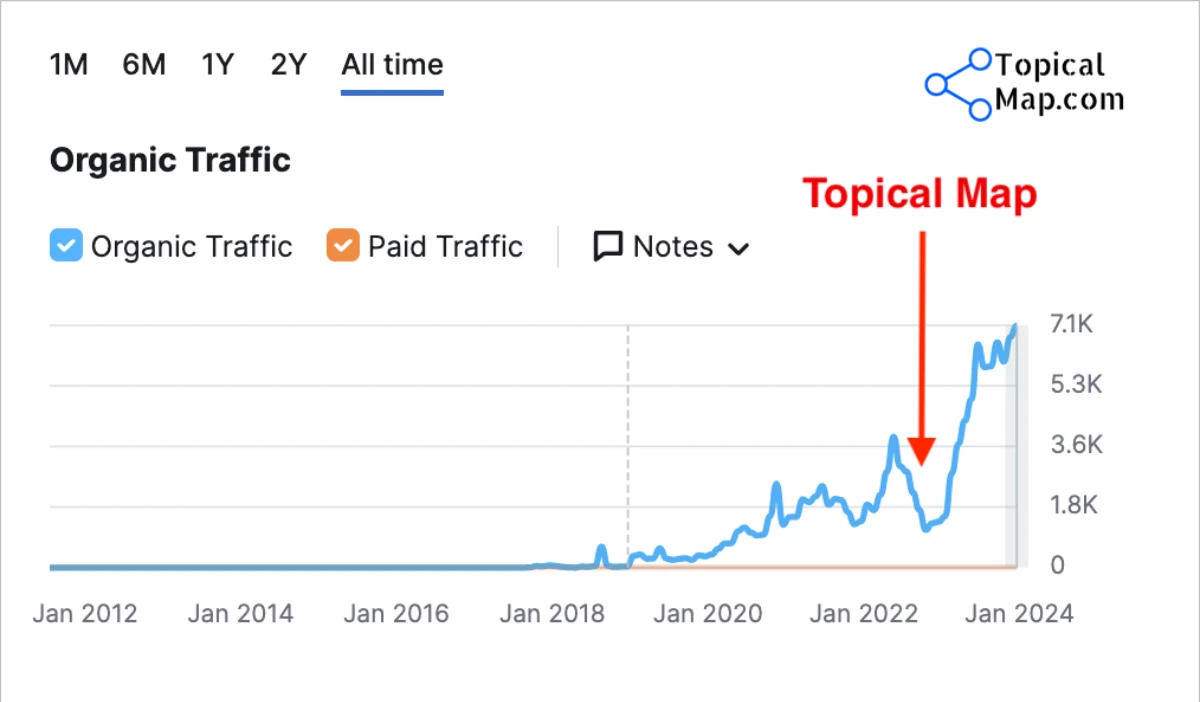
The site had content but no coherent structure. Pages competed with each other, confusing search engines. None of the pages owned a topic.
We rebuilt the strategy around what their buyers actually research, audited the existing content against it, and fixed the internal linking so the site built topical authority on its core subject instead of reading as a pile of posts.
Organic traffic grew 295% over 10 months. Demo requests went from 4 to 19 a month.
Media SaaS startup: zero content to 114,000+ monthly organic visits
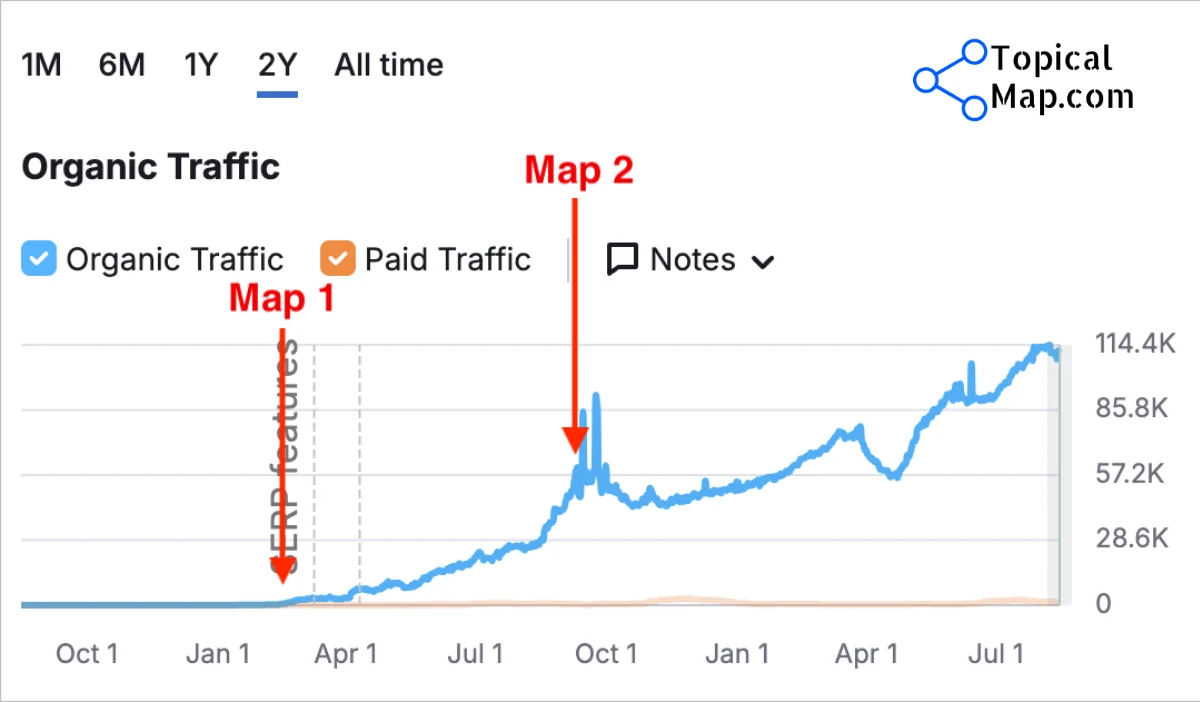
A brand new site that started with nothing. No blog, no rankings, no organic pipeline.
We built the topic strategy first, then a focused publishing plan that covered the subject completely instead of chasing individual keywords. Topical authority compounds, so each round of publishing made the next one rank faster. A second round of strategy work expanded coverage once the foundation held.
They now see over 114,000 organic visits per month, roughly 18 months from launch. New trials run 670 to 1,200 a month.
Chiropractic practice: zero to 5,000+ monthly organic visits
Professional services
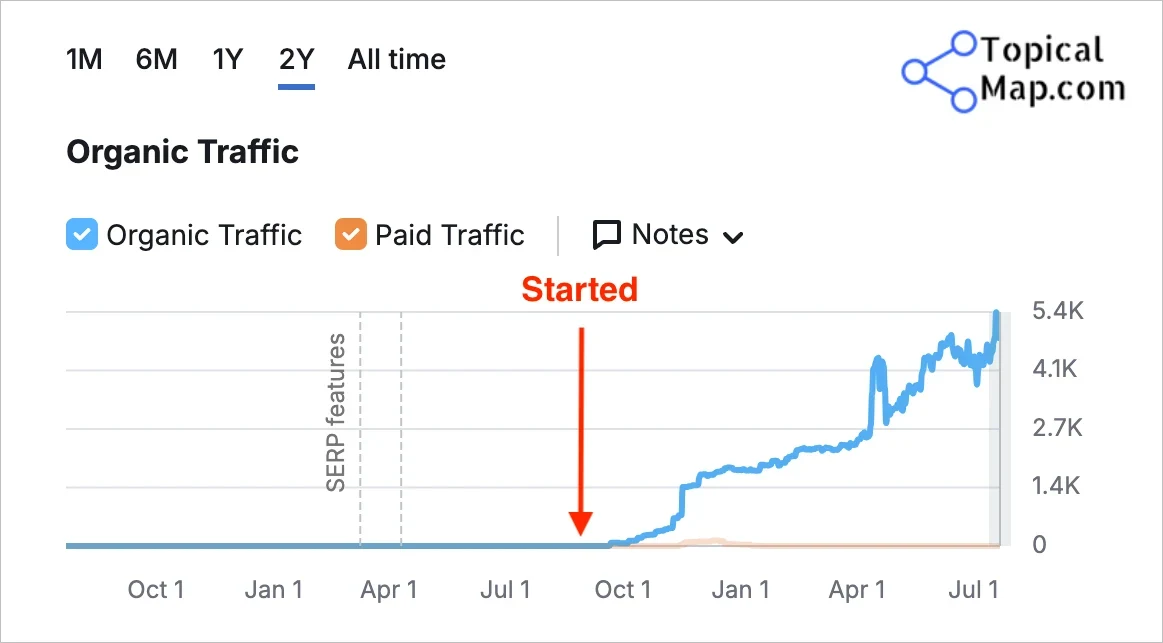
A one-year-old licensed practice, not a software company. Nothing about our method changes. Whenever there’s a buyer who researches before they commit, the same work applies.
They had built their own starter website and it was doing nothing for a year. We redesigned and rebuilt it, optimized it properly, and built the content strategy from scratch against what patients actually search before they book.
We also made sure their Google Business Profile, social media and citations all pointed to the same topics and the same website, so Google could trust the site as a source.
Organic visits went from zero to more than 5,000 a month in nine months. The practice takes 20 to 40 new bookings a month from the site.
Flooring company: 100 to 2,600 monthly visitors in under six months
Local service business
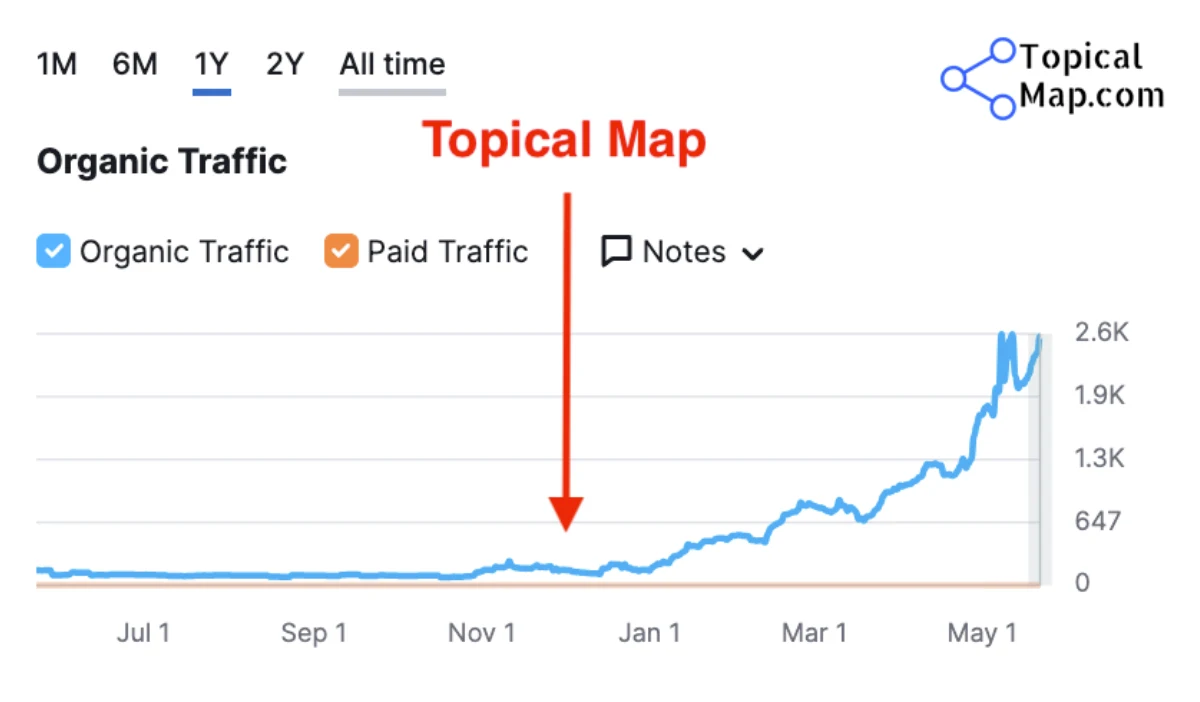
A two-year-old site with e-commerce and design consultation requests on it, but none of them earning anything because there was no organic traffic.
We mapped the topics their customers search before they buy, improved the existing pages against that map, and fixed the internal linking. We also put together a content strategy and publishing plan to keep the site growing.
Monthly visitors went from 100 to 2,600 in less than six months. Design consultation requests now come in at 11 to 20 a month.
As a new startup we had a lot of expertise about our topics, but not enough SEO experience to know how to share that knowledge. The topical maps gave us clear direction on what to write about, the search intent behind it, and even what type of article each one should be.
In a lot of markets the larger companies never had to focus on SEO because everyone already knows their brand. That gave us, as a newcomer, the opening to create fully optimized content off the topical map. It resulted in a lot of top three rankings above the big brands. Organic search and AI traffic is now our largest acquisition channel.
how it works
SEO and AI search strategy, carried through to what ships
You get senior direction, a roadmap built around your buyers, and a person who stays to build it or to make sure your team does.
The work here builds toward a single outcome. Your business becomes the most complete and most trustworthy source on the subjects your buyers care about. That’s what topical authority is, that’s what earns rankings, and it’s the same thing that earns citations in AI answers.
More presence in search results means more qualified inquiries. More qualified inquiries means more revenue. That’s the outcome, and it’s what I measure.
Engagements usually fall apart at the handoff, where someone delivers a strategy and the client has no capacity to build it. So who builds it is settled before the strategy is written, and the four engagements below are the four answers.
- 01
Find the gaps
I audit your website, your competitors and where you currently show up across Google and the AI engines. You get a clear read on what's working, what's missing and where the strategy is breaking down. Nine times out of ten the problem is not effort. It's that the effort was pointed at the wrong things.
- 02
Build the roadmap
Your brand, your buyers and your commercial goals become a topic strategy, a site structure and a prioritized content plan. I don't take your industry and map everything in it. The plan covers what your brand can credibly own and what your buyers actually need on the way to a decision. Prioritized matters too. You'll know what to publish first, second and third, and why that order produces results faster than publishing whatever's convenient.
- 03
Build it and ship it
Briefs, page architecture, internal linking, on-page work and the priority pages themselves. How much of that I do personally is what separates the two fractional tiers below. On advisory I write the briefs and direct your team. On hands-on I'm in the site doing the on-page and technical work and writing the pages that matter most. Either way I review what ships, because this is where engagements stall: a strategy gets handed over and quietly drifts.
- 04
Earn the mentions and citations
Rankings and AI citations both run on signals you can't manufacture from your own website. I map which outside sources actually get cited in the answers that matter on your subject, then set the digital PR, link and brand-mention targets. Your team, your PR partner or Main Heading goes after them at volume. On-page work makes you eligible. Off-page work is what gets you picked.
- 05
Prove it's working
Monthly reporting on your rankings and on where your brand is being mentioned and cited across the AI engines, delivered as a short written summary and a working session with your team. Not a dashboard nobody opens. A straight answer to whether the investment is working and what your team builds next.
What you actually receive each month: The fractional engagement is scoped to your site and your team. A site with 200 existing pages and a positioning problem needs a very different month from a site starting at zero, so the priorities, the briefs and pages I owe you and the expected pace are written into the proposal before we start.
engagements
Four ways to work with me
The difference between them is how much of the execution sits with me and how much sits with your team. The strategy is the same in all four.
- 01
Strategy engagement
From $3,500 One-time, four to six weeks
The full strategy phase: audit, topical map, site architecture, prioritized roadmap and the first round of content briefs. Built for your site and your market, not assembled from a template.
- Topical audit of your site, your competitors and your visibility across Google and the AI engines
- Topical map and site architecture built on what your brand can credibly own
- Prioritized publishing roadmap: what ships first, second and third, and why that order
- The first content briefs, written against the map
- A working session to hand it over to whoever is building it
Stands on its own. Your team, your agency or Main Heading can build from it without me staying on.
- 02
Fractional SEO, advisory
From $3,000/month Weekly call. Three-month minimum, then month to month.
Strategy plus ongoing senior direction for a team that can execute. I set the priorities, write the briefs and review what ships. Your writers, developers or agency do the building.
- Everything in the strategy engagement, delivered in the first month
- From six content briefs a month, written against the map and your priorities
- A weekly call, plus Slack or email between calls
- Review of what your team publishes, with on-page and internal linking direction
- Off-page targets: which outside sources to pursue for mentions, links and citations
- Monthly written reporting on rankings and AI citations
Roughly 15 to 20 hours of my time a month.
- 03
Fractional SEO, hands-on
From $5,000/month Weekly call. Three-month minimum, then month to month.
Everything above, and I do the work that needs a senior person doing it rather than briefing it. For companies with a small team or no SEO hire, where the alternative is a $150,000 salary and a three-month hiring cycle.
- Everything in the advisory tier
- On-page optimization and internal linking, done by me rather than specified for someone else
- Technical SEO direction, schema and site structure work, with sprint-ready briefs for your developers
- From six priority pages a month written or rebuilt to the map, by me
- AI search visibility work: entity signals, structured data and citation tracking
- Direct work with your writers so what they publish holds the standard
Roughly 30 to 35 hours of my time a month.
- 04
Main Heading, my agency
From $5,000/month Six-month initial term. Local program from $1,000/month.
Same strategy, same person leading it, a team's hands instead of mine. Main Heading is the SEO and AI SEO agency I founded. Specialists do the research, content, technical work, publishing, digital PR and reporting, and the scope scales past what one person can ship. It also runs the local program and one-off deep dives, which don't live on this page.
The right call when you need it at agency volume, or when you want the work handled by a team rather than by one person.
On the prices: these are floors, not quotes. Site size, competition and how much of the execution sits with me move the real number, and the proposal names it before anything starts. If you’re not sure which rung you need, send your URL. The audit is the same either way, and I’ll tell you on the readout which one fits.
the obvious question
Yes, I built the software. Here’s why that’s good for you.
I’m the founder of Floyi, the topical authority platform built for organic growth and AI search visibility. Fair question to ask whether hiring me is really a funnel into a subscription.
It isn’t. Not one of the clients on this page is a Floyi customer. You don’t need an account, and you’re never asked to buy one. I built the platform because I was doing this work by hand across hundreds of sites and needed a way to run faster.
What that means for you is simple. Mapping and analysis that once took weeks of manual work runs in a fraction of the time, so more of your budget goes into content that ships instead of spreadsheets that don’t.
definitions
The terms, in plain English
Two of these are what the work builds. Four are what the industry calls it.
Topical authority and topic ownership
| Term | What it means |
|---|---|
| Topical authority what the work builds | How completely and coherently your site covers a subject, and how consistently Google and the AI engines treat you as the source for it. It compounds. Every page that fits the subject makes the next one easier to rank. |
| Topic ownership what authority earns you | What topical authority looks like once you have enough of it. Google, the AI engines and your buyers all associate one subject with your business. Not a keyword. The whole subject. |
Google measures this directly. When its internal Content Warehouse API documentation leaked in 2024, three attributes turned up in a module named for topic authority:
-
siteEmbeddingA compressed numeric representation of what the whole site is about. -
siteFocusScoreHow much the site concentrates on a single topic. The tighter the focus, the more authoritative the site can look on that topic. -
siteRadiusHow far an individual page drifts from what the site is about.
A site that covers one subject deeply scores as focused. A site that publishes whatever is convenient scores as scattered, and every off-topic page drags the average further from the thing you wanted to be known for. Publishing more can leave you worse off than publishing nothing.
SEO, AEO, GEO and AI search
You’ll see these four used loosely and often interchangeably.
| Term | What it means |
|---|---|
| SEO Search Engine Optimization | Showing up when someone types a question into Google or Bing. The original discipline, and still the largest source of qualified lead traffic for most businesses. |
| AI search the umbrella term | Showing up when someone asks ChatGPT, Claude, Perplexity, Google AI Overviews, Google AI Mode, Gemini, or Microsoft Copilot. These tools synthesize an answer and name a handful of sources instead of returning a page of links. |
| AEO Answer Engine Optimization | Structuring your content so it gets selected as the answer rather than buried as one option among many. |
| GEO Generative Engine Optimization | Getting your brand named, and your pages cited as the source, inside an AI-generated answer. |
Ranked in Google. Picked as the answer. Cited as the source. Mentioned and recommended by name.
Those are four different outcomes, and the work that earns each one differs at the edges. Underneath, they run on one foundation, and topical authority is that foundation.
What changes between businesses is the mix. A local practice whose patients search on their phones and a B2B platform whose buyers compare vendors for six months need different emphasis on the same foundation. I set that against your goals, not against whichever acronym is selling this quarter.
Do it properly and all four arrive together. Buy them as four separate projects and you pay four times for one outcome.
fit
Not everyone should hire me
Who this is for
- You rely heavily on referrals and want a second, more predictable source of qualified inbound inquiries.
- You're publishing content already, but the pages don't add up to a coherent strategy.
- Competitors show up in Google and in AI answers while your expertise stays invisible.
- You have a team, an agency or writers who can execute. What's missing is the senior direction telling them what to build, in what order, and why.
- You don't have an SEO hire and don't want one yet. You want the senior half of that role, doing the work, for a fraction of the salary.
- You want a strategic partner to guide you across everything search, not a vendor waiting on instructions.
- You want to work directly with the person doing the thinking.
- You're making an ongoing investment in content rather than looking for a one-time project.
Who this isn’t for
- You want the cheapest option available. There are plenty. This is not one of them.
- You need results in 30 days. Topical authority compounds, which means it starts slow. The first meaningful movement typically shows up in months three to six.
- You want a strategy document and nothing else. I do sell strategy-only work, but the results on this page came from strategy plus execution, whether your team did the building or mine.
- You need more volume than one person can ship in a month. That's the case for Main Heading, my agency, rather than for this page.
- Your business doesn't have expertise worth publishing. This approach turns real knowledge into visibility. I won't manufacture the knowledge for the business.
proof
The agencies that do this for a living hire me to do it for their clients






When an SEO agency outsources the strategy work to someone else, it’s because that part is harder than it looks.
- 300+ brands served, each with its own topical strategy
- 2,000+ SEO professionals trained through Topical Maps Unlocked
- 5+ years publishing the Digital Surfer newsletter every week
Just topped 15,000+ pageviews in only 5 months! Traffic has been steadily increasing. I now have enough in the pipeline to keep me busy for months.
He gave me the topics, site structure, and internal linking strategy for a site I am building on an aged domain. I recommend his service!
about
Who you would actually be working with

I’m the founder and CEO of Floyi, the founder of Main Heading, an SEO and AI search agency, and the founder of TopicalMap.com.
I didn’t learn this from a course. I learned it running businesses of my own, where search was the entire pipeline and a bad quarter showed up in the bank account rather than in a report. The method came out of that, not the other way around.
Since then I’ve built topic strategies for over 300 brands, trained more than 2,000 SEO professionals, and published the Digital Surfer newsletter every week for over five years.
I still work from the operator’s seat, which is why the engagement follows the plan through to what actually ships, and why the monthly reporting answers whether the investment is working rather than how busy I was.
questions
The things people ask first
Is this a monthly retainer?
The strategy engagement is one-time. The two fractional tiers are monthly, with a three-month minimum and month-to-month terms after that. Three months is the floor because the first month is diagnosis and the second is when the roadmap starts shipping. Anything shorter buys a document, not a result.
How long before I see results?
Expect the first meaningful movement between months three and six, and compounding growth after that. Anyone promising rankings in 30 days is either selling you something that won't last or was handed a site that already had the foundation. Sites with existing content and authority move faster than sites starting from zero.
What does it cost?
The strategy engagement starts at $3,500. Advisory fractional starts at $3,000 a month, hands-on at $5,000 a month, both on a three-month minimum. Those are floors rather than quotes. Site size, competition and how much of the execution sits with me move the real number, and the proposal names it before anything starts.
Do you work in my industry?
I've built strategies across software, e-commerce, finance, healthcare, professional services, and local service businesses. The method doesn't change by industry. What changes is what your buyers research before they commit, and that's the first thing I dig into.
What if I already have an agency, a content team or writers?
That's the setup this page is built for. I build the strategy and the briefs, your team executes against them, and I stay on to review, prioritize and report. Your writers stop guessing what to write, and your agency gets a roadmap instead of a monthly keyword list. I've worked alongside agencies for years and can work with yours on strategy, briefs and reporting without stepping on toes.
What if I don't have a team to execute?
You can still work with me directly, as a consultant or as your fractional SEO. The hands-on tier is built for this: I do the on-page, the technical work and the priority pages myself, so nothing waits on a hire you haven't made. If you'd rather have a team behind it, that's Main Heading, the agency I founded, and it starts at the same $5,000 a month. Same strategy either way. The difference is whose hands are in the site, mine or a specialist team's, and how much has to ship each month. Tell me how fast you want to grow and where, and we'll work out which one fits on the call.
How much of my time does this take?
A kickoff session, then the weekly call and a short interview when a page needs expertise only you have. Call it two to three hours a month. You're the subject matter expert, so I pull your knowledge into the content through conversation rather than asking you to write.
How is this different from buying a topical map from TopicalMap.com?
TopicalMap.com sells the topical map as a one-time product. It's the right buy when you already know your positioning and just need the map itself. It doesn't include content briefs or written articles, and it doesn't come with anyone attached to it afterwards. The strategy engagement here starts further back, at what your brand can credibly own, how the site should be structured around that and what order to publish in. The map is one output of the work rather than the whole deliverable, and I stay on it. If what you want is briefs and finished articles, that's a fractional engagement here, or Main Heading when you need them at volume.
Do I have to write anything myself?
No. On the advisory tier I write the briefs and direct your writers. On the hands-on tier I write or rebuild six priority pages a month myself and your team covers the rest. Where a page needs a point of view only you have, we capture it in a conversation and I write from that. If nobody in-house should be writing at all, Main Heading covers the full volume.
Can you work with my existing website?
Yes. WordPress, Webflow, Shopify, HubSpot, Astro, and most common platforms. If your site is on something unusual, tell me on the call and I'll be honest about whether it's a problem.
Where are you based?
Taipei, working US Eastern hours. Calls, reporting and turnaround run on your schedule, and clients across the US have worked with me this way for years.
next step
Start with a free topical audit
Send me your URL. I’ll run a quick topical audit of your existing content and send back a short video showing what your site appears to be trying to own, where your coverage is concentrated and the clearest gap worth fixing.
No charge, no obligation, about five minutes of your time to watch it. Video back within two business days.
Or email me directly at [email protected] · linkedin.com/in/yoyao
Over 300 topical strategies delivered.
Results shown are from past client work. Outcomes vary by market, competition and execution.