How Agencies Can Pitch Topical Authority to Clients
You understand topical authority better than your clients do. That’s the problem.
I’ve had this conversation dozens of times with agency teams. They know the methodology cold. They can map topics, build coverage matrices, design internal linking architecture. But when they sit directly across from a client, the pitch falls flat.
Not because the work isn’t good. Because the translation fails.
Clients don’t need to become an expert on the methodology to approve the work. They need three things:
- The gap - where they’re exposed
- The plan - what you’ll do about it
- The business logic - why this matters for revenue
Most pitches fail because they lead with SEO theory instead of business outcomes. You explain topical maps, entity coverage, semantic depth. The client nods and thinks: “I have no idea what you just said, but it sounds expensive.”
Here’s a different approach. A way to frame topical authority so clients get it, approve it, and can explain it to their boss.
Why Clients Struggle With Topical Authority
Topical authority sounds abstract. That’s the core issue.
When you say “we need to build topical authority,” clients hear “we need to write more blog posts.” They equate it with content volume, not strategic coverage.
Here’s a better way to say it: “Traditional and AI search engines expect authoritative sources to cover a topic thoroughly. If you only have two pages about [topic], you don’t look like an authority. You look like you dabble.”
I saw this happen recently with a B2B SaaS client. The agency had told them they needed a lot of articles to build topical authority. The explanation stayed vague: “this will help build topical authority.” The client kept approving. The agency kept publishing. This went on for months.
Eventually the marketing director asked a reasonable question: “What is the actual plan here?”
She wanted to see the topical map. What she got back was a keyword list.
That was the trust-breaking moment. Not because the agency was incompetent. Because they had never translated the methodology into something the client could see and evaluate. The client realized she had been approving work for months without understanding what “done” looked like.
A keyword list is not a plan. A topical map is the plan.
This creates three problems:
-
They can’t see the gap. You know they’re missing entire topic clusters. They see a keyword list and assume coverage.
-
They can’t evaluate the plan. When you propose 47 new pages, they have no framework to judge whether that’s too many, too few, or the right priority order.
-
They can’t measure progress. Rankings fluctuate. Traffic fluctuate. Without a model that connects coverage to authority to outcomes, every dip looks like failure and every spike looks like luck.
The fix isn’t to simplify your methodology. The fix is to change what you lead with.
The Wrong Way to Pitch It
I’ve watched enough agency pitches to know the patterns that fail.
Mistake 1: Leading with jargon.
“We need to build topical authority through entity-optimized content clusters supported by internal link equity flow.”
The client hears noise. They approve because they trust you, not because they understand. That trust erodes when they can’t explain the decision later.
Mistake 2: Leading with volume.
“We recommend publishing 60 articles over the next quarter.”
This triggers the wrong question: “Why 60? Why not 40? Why not 80?” Without a framework, the number feels arbitrary. And arbitrary numbers get cut.
Instead, try: “The goal isn’t volume. It’s coverage. We’re not guessing what to write. We’re mapping what search engines already expect to see, then building that.”
Mistake 3: Leading with rankings alone.
“This will improve your keyword rankings.”
Maybe it will. But rankings are volatile and competitive. If you sell rankings and they don’t materialize fast enough, you lose the account.
Mistake 4: Drip-feeding without a plan.
Some agencies hand clients one cluster or pillar at a time, month by month, without ever showing the full picture. The client gets a queue of deliverables but never sees how they connect. This isn’t a strategy. It’s a subscription.
When you drip-feed isolated clusters without showing the full map, the client can’t understand what’s being tackled now, what comes next month, what happens in six months, and why. They’re approving tasks blind.
The better approach: lead with coverage gaps, competitive exposure, and a plan tied to business outcomes.
The Right Way to Frame It: Gap, Plan, Logic
Clients approve work they can explain to their boss. Your job is to give them that explanation.
Here’s the framework that works.
1. The Gap: Show What’s Missing
Don’t talk about topical authority as a concept. Show the coverage gap visually.
“This is your core topic. These are the subtopics search engines expect to see covered by any authoritative source. The green ones you have. The red ones you don’t.”
Then compare them to a competitor:
“Your competitor covers 65% of this topic. You cover 30%. When someone searches [core topic], they’re twice as likely to find your competitor first. They’re not just ranking higher. They’re the brand searchers find. You’re invisible.”
This is concrete. The client can see the exposure. They can feel the competitive threat.
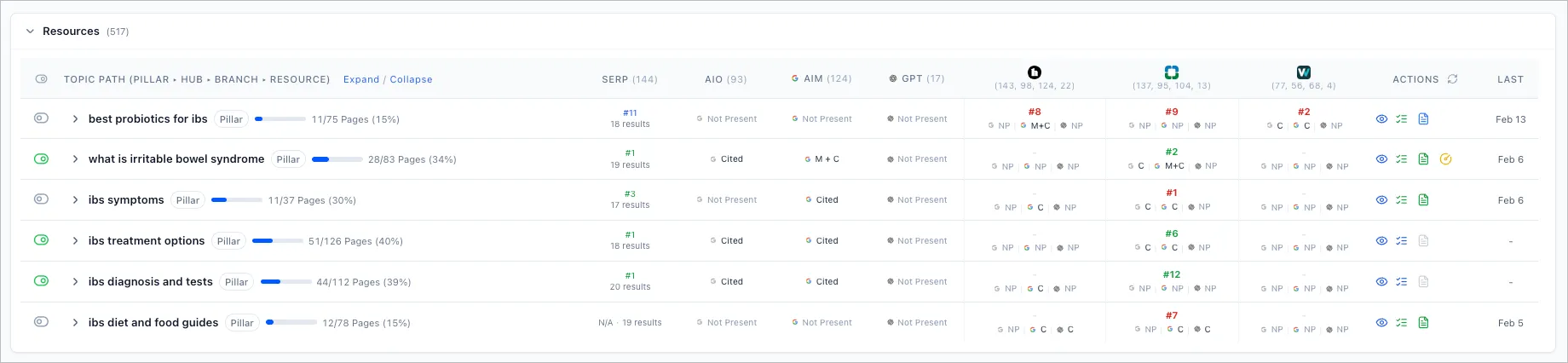
One agency I worked with started opening quarterly reviews with a side-by-side coverage view: client vs. competitor. It didn’t eliminate objections. But once the client could finally see their coverage next to a competitor’s, the conversation changed. It went from “why are we publishing so much?” to “how do we close that gap?” and “which gaps matter most first?”
That’s the shift you want. Not blind approval. Informed prioritization.
2. The Plan: Show What You’ll Build
Now connect the gap to a specific plan. This is where most agencies fail.
The wrong approach: hand the client one cluster this month, another cluster next month, with no visible roadmap. The client gets deliverables but never sees how the pieces fit. They can’t answer simple questions from their boss: “What are we covering? When do we finish? Why this priority?”
The right approach: show the full topical map upfront.
The topical map is the strategic plan. It shows every pillar, every cluster, every page the client needs to own the topic. Then you slice that map into monthly or quarterly priorities. The client sees the whole battlefield and understands where each battle fits.
Here’s how to frame it:
- This quarter: We’re closing the gap on pillar A and its four supporting clusters. This is the foundation.
- Next quarter: We move to pillar B, which targets buyers in the consideration stage.
- Six months out: We expand into adjacent topic C, which builds on the authority we’ve already established.
- Ten months out: We’re at 85% coverage. The moat is real. Competitors can’t catch up quickly.
A keyword list is not a plan. Drip-feeding isolated clusters is not a plan. The plan is the full topical map. The roadmap is the prioritized slice of that plan.
Show the client the map. Explain the slices. They’ll understand what’s being tackled now, what comes next, and why.
3. The Logic: Connect to Business Outcomes
Now the client can see the gap and the plan. The final step is the business logic.
Don’t just say “this will drive traffic.” Put a number on what’s at stake.
Here’s the model:
Search volume x CTR x site conversion rate x lead-to-close rate x average deal value = potential revenue
Let’s walk through a realistic example. Say you’re working with a B2B SaaS client in the project management space. There’s a high-intent topic cluster with the following characteristics:
- Monthly search volume: 12,000 searches across the cluster’s core terms
- Position 1 CTR: ~28% (based on Advanced Web Ranking and similar studies)
- Site conversion rate: 3% (typical for B2B SaaS landing pages)
- Lead-to-close rate: 15% (conservative for warm, inbound leads)
- Average deal value: $15,000 annual contract value
Run the math:
- 12,000 searches x 28% CTR = 3,360 monthly visitors
- 3,360 visitors x 3% conversion = 101 leads per month
- 101 leads x 15% close rate = ~15 closed deals per month
- 15 deals x 225,000 in monthly recurring revenue potential**
That’s roughly $2.7 million annually from one topic cluster. This is directional modeling, not a guarantee. Search volumes shift. Conversion rates vary. Competitors fight back. But the exercise gives you a concrete way to talk about what’s at stake.
Frame it to the client like this:
“If you captured position 1 across this cluster, the revenue potential is approximately $2.7 million per year. Right now, your competitor is capturing most of that. As we close the gap, you start showing up in more searches. Not just for one keyword, but across the entire topic. That’s more traffic, more leads, and a moat that gets harder for competitors to breach.”
The logic is simple:
- Gap = exposure
- Plan = path to coverage
- Logic = why it matters for revenue
Why You Shouldn’t Hide the Map
Some agencies hesitate to share the full topical map with clients, even though the clients paid them to create it. They worry the client will take the plan, fire the agency, and execute it themselves, maybe with AI tools or a cheaper vendor.
If that’s your fear, pause and ask why.
Remember, the map is not the service. The map is the plan. The service is everything required to make that plan actually work.
Clients aren’t paying for a document. They’re paying for results. The real value is in everything that happens after the map gets delivered:
-
Creating a strong map in the first place. Anyone can list topics. Not everyone can diagnose which topics matter, which are competitive blind spots, and which will move revenue.
-
Maintaining the map as reality changes. Search landscapes shift. Competitors pivot. New terms emerge. The map that worked six months ago may need adjustment today.
-
Executing against the map correctly. A page on the right topic still needs to win. That means strong research and writing, proper structure, and content that satisfies both search algorithms and humans.
-
Prioritizing the right parts at the right time. Not every gap matters equally. The skill is knowing which 20% of the work drives 80% of the impact.
-
Handling the execution details that make the plan work. On-page optimization. Internal linking architecture. Source selection and citations. Technical foundations. These are the layers that separate pages that rank from pages that exist.
-
Connecting content to broader SEO strategy. Content doesn’t operate in isolation. Off-page SEO, site authority, and technical health all factor into whether the map translates into rankings.
If you’re afraid to show the map, the issue isn’t the map. The issue is the fear of execution.
An agency that hides the plan is signaling that the plan itself is the product. That’s a weak position. It implies the client could take the map and get the same result somewhere else, maybe cheaper.
But that only happens if the agency’s execution is replaceable. If the work relies too heavily on AI without human judgment. If juniors push deliverables they don’t fully understand. If the process lacks the oversight that turns content into something worth publishing.
Hiding the map isn’t a sign of strength. It’s a sign that the agency knows, somewhere deep down, that the execution might not hold up under scrutiny.
Confidence comes from knowing you can create, maintain, prioritize, and execute better than the client can on their own. The map is the plan. Your value is in making that plan work in the real world.
Share the topical map. Explain the roadmap. Then deliver execution that makes the client glad they stayed.
If a client asks “but can’t someone else just follow this map?” You now have the answer: “Anyone can publish blog posts. Not everyone can build a structured topic architecture that compounds topical authority over time. That’s the moat.”
And if they ask about AI search, you’re ready: “AI answers pull from sources that cover topics comprehensively. If you’re the authority on [topic], you’re more likely to get mentioned and cited in AI responses. This work positions you for both traditional search and AI.”
How to Turn Strategy Into an Execution Plan
Clients approve strategy. Then they want to know how it gets done. This is where most agencies default to a generic “map, audit, prioritize, execute” playbook. The client has heard that before. What they haven’t heard is how the plan actually survives contact with reality.
Here’s what separates agencies that retain accounts from agencies that lose them after two quarters.
Start With What They Already Have
Most agencies pitch as if the client is starting from zero. They’re not. The client has existing pages, some ranking, some not, some cannibalizing each other. The first move isn’t to propose new content. It’s to show the client what they already own and how it maps (or doesn’t) to the topical structure and their competitors.
This does two things. It proves you’ve done the homework. And it reframes the project from “we need to create 50 pages” to “you already have 20 assets — 8 are strong, 5 need rework, 3 should be merged, and there are 15 gaps to fill.” That’s a very different conversation. The scope feels manageable instead of overwhelming.
Set a Coverage Target, Not a Content Quota
Don’t promise “30 articles this quarter.” Promise “we’ll move from 35% topic coverage to 60% by Q3.” Coverage is the metric that connects directly to authority. It’s measurable, it’s defensible in a board review, and it doesn’t invite the “why not 25 articles instead?” negotiation.
When you frame progress as coverage percentage, the client stops counting deliverables and starts watching the gap close. That’s a healthier dynamic for both sides. This is one of the patterns that compounds — measuring topic ownership instead of content output.
Build the Review Cadence Into the Plan
The number one reason clients lose confidence isn’t poor execution. It’s silence. They approved the strategy three months ago and haven’t seen an update that connects work to progress.
Build a monthly or quarterly review into the plan from day one. Not a status call. A coverage review: “Here’s where we were. Here’s what moved and why. Here’s what’s next.” Show the coverage comparisons — side-by-side, client vs. competitor. Show share of voice changes. Show AI visibility if you’re tracking it.
Clients trust what they can see. Coverage comparisons, share of voice numbers, and AI citation tracking survive scrutiny in executive reviews. Rankings alone don’t.
Know When to Re-Prioritize
Keep the topical map plan flexible. The map you build in month one will need adjustment by month four or earlier. A competitor publishes a definitive guide on a subtopic you planned to cover. A product launch shifts the client’s priorities. A new search feature changes what “visibility” means.
Agencies that treat the topical map as a living document retain clients. Agencies that treat it as a fixed deliverable lose them. The skill isn’t just building the initial map. It’s knowing when to move pieces around — and explaining to the client why the adjustment makes the plan stronger, not weaker.
Making This Practical for Agency Teams
You can borrow this framing directly in client meetings:
- Open with the gap: “Let me show you where you’re exposed.”
- Show the competitive view: “Here’s what [competitor] covers that you don’t.”
- Present the full plan: “Here’s the topical map. Here’s this quarter’s slice.”
- Connect to outcomes: “If you captured this demand, the revenue potential is approximately X.”
- Answer questions with proof, not theory: “Let me show you the data.”
The pitch stops being “trust us, we’re experts” and becomes “here’s the evidence, here’s the plan, here’s why it matters.”
That’s a pitch clients can approve and defend.
The Operational Layer
Agencies that sell topical authority well still need to execute. That’s where most teams struggle.
The work is the hard part: mapping topic scope across dozens of clients, running SERP analysis and clustering, tracking coverage gaps over time, measuring authority against competitors, generating briefs that inherit the strategy, publishing and reporting at scale.
This is where tools help. Floyi connects the full workflow: brand context, topical maps, authority scoring across Google and AI search, briefs, drafts, and WordPress publishing. It’s built for agencies managing multiple client brands in one system.
You can start free and try the full workflow on a demo brand before spending credits. For agencies evaluating topical authority execution at scale, it’s the operational layer behind the pitch.
Clients don’t buy methodology. They buy confidence that you understand their brand, their business, their target buyer persona, their exposure, and have a plan to fix it. Lead with the gap. Show the full map. Connect it to revenue. Then execute well enough that the client renews.